


C8 Vertical Door Kits: Where the Design Differences Matter
A vertical door conversion should do more than create a dramatic photograph. The hinge has to carry a heavy original Corvette door through its outward swing and upward lift, keep the motion controlled, and remain practical to adjust and service after the bodywork is reinstalled. Those are the details that determine the ownership experience.
This article examines the traditional Vertical Doors, Inc. C8 system Eikon has serviced and explains why Eikon chose a different bearing and arm-support arrangement for the V2 Series. The photographs below show actual components and a specific customer’s removed VDI kit. Customer symptoms, Eikon’s inspection findings and mechanical explanations are identified separately.
Eikon has replaced approximately 31 VDI C8 kits with V2, according to owner and installer Tim Court. That service experience is the basis for the observations here. This is a manufacturer’s comparison, not an independent laboratory durability study, and it does not establish that every VDI installation has the same condition.
One VDI C8 Kit After Four Months: The Visible Wear
The first two photographs show the same VDI assembly removed from a customer’s C8 Stingray after four months of use, as documented by Eikon. The customer reported difficult lifting, wobble and squeaking and chose a V2 conversion. The close-up shows a distinct contact track on the arm near the black support component.

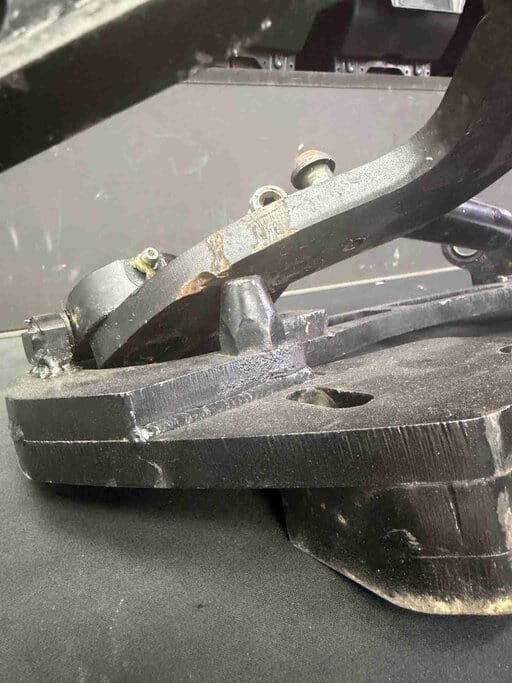
What is creating the contact track?
Tim attributes the groove to the large black, nut-shaped contact component sliding against the back of the arm during raising and lowering. The separate lateral adjustment screw is the hex-head screw above and just to the right of the rotation point. These are different parts: the adjustment screw should not be labeled as the component rubbing the wear track.
The photograph records the surface condition of this assembly. The four-month history and reported symptoms come from Eikon’s customer and service record. A photograph alone cannot measure groove depth, quantify the resulting clearance, or prove the maintenance and adjustment history of the kit.
Why a changing contact surface matters
When an arm moves against a sliding support, the same surfaces repeatedly pass across one another under load. Contact pressure, alignment, surface condition and lubrication influence how that interface behaves. If wear changes the support surface, the relationship between the arm and its support can change, potentially affecting contact or clearance. An installer must assess the actual assembly before attributing door play or noise to one component.
The concern demonstrated here is specific: the inspected arm has a visible contact track at a working interface. It is a reason to examine the support design and the condition of the parts, rather than dismissing every report of wobble or squeaking as something that only needs another adjustment. It is not evidence of a universal failure time or of an imminent structural failure.
Sliding Contact Versus V2’s Rolling Arm Support
Eikon’s V2 uses a separate 1-inch sealed ball-transfer bearing assembly behind each hinge arm. As the arm moves, the ball can roll at the contact interface instead of a fixed contact surface being dragged along the arm. There is one assembly per hinge and two per complete kit.
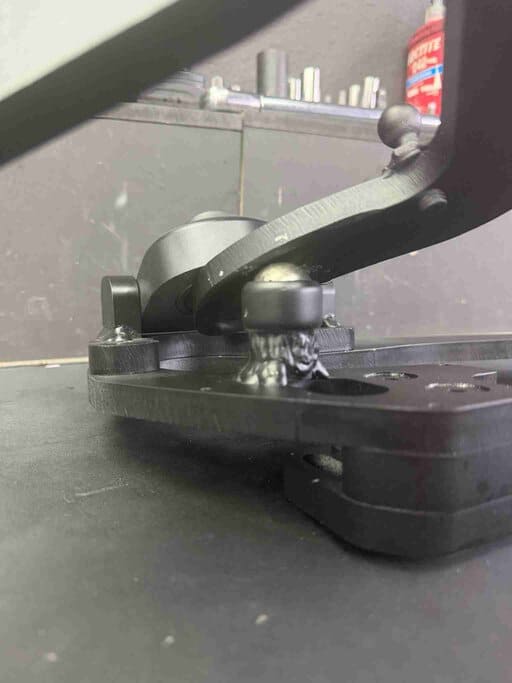
This is the design distinction the side-by-side photographs explain: sliding support at the inspected VDI interface versus rolling ball support in V2. Rolling support reduces reliance on sliding at that contact. It does not eliminate all friction or prove a particular service life; a ball-transfer assembly also depends on its condition, load and correct installation.
The ball-transfer bearing supports the arm path. It is not the main up-and-down hinge bearing, and it should not be confused with the ball-and-socket attachments at either end of a shock. Each component performs a different job.
Inside V2: Separate Bearings for Separate Movements
Main lift bearings
Each V2 hinge contains two sealed main bearings for the up-and-down motion, with a 2-inch outside diameter and a 1-inch inside diameter. A complete driver-and-passenger kit contains four main bearings. The main housing supports the rotational movement instead of asking the arm-support ball to act as the main pivot.
Outward-swing tab bearings
The upper and lower tabs each contain another sealed bearing. A press-fit rod connects the housing and tabs for the inward and outward movement. That adds two tab bearings per hinge, or four per complete kit. Across both doors, the kit therefore has eight main-and-tab bearings plus two separate ball-transfer assemblies.
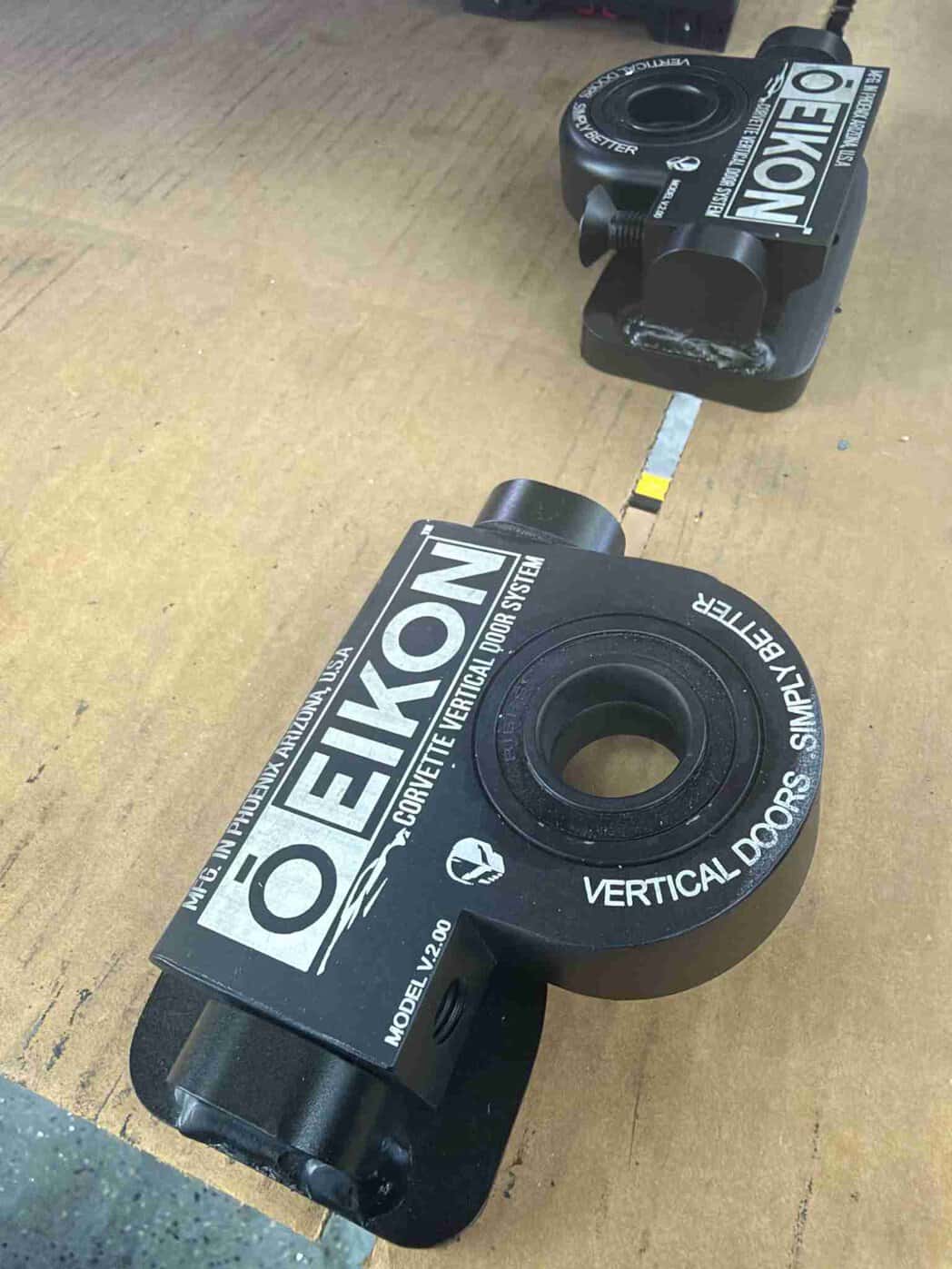
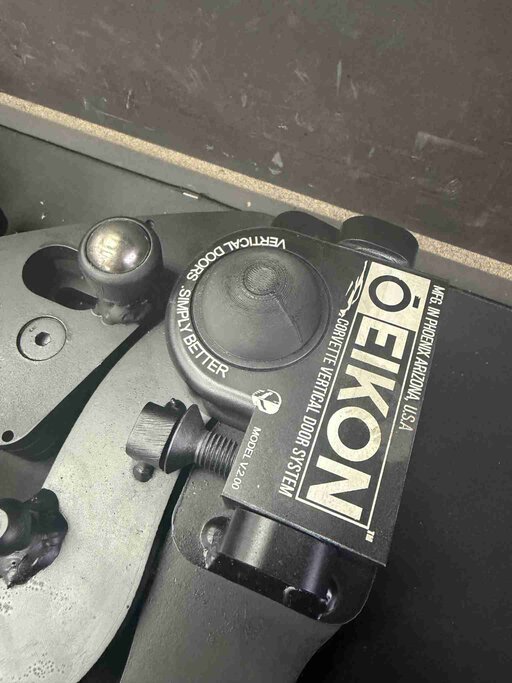
See the V2 engineering specifications for the component descriptions. Eikon markets the overall bearing-supported approach as RollerBall™ technology; the useful comparison is the actual hardware and load path, rather than the name alone.
Grease Requirements: A Real Ownership Difference
A grease fitting does not, on its own, prove a defective design. Bushings and lubricated joints are legitimate mechanical approaches when correctly specified and maintained. The useful question for a C8 owner is what service the particular kit requires and whether those points remain accessible after installation.
As checked November 2, 2026, VDI’s published maintenance and warranty terms call for hinge grease-fitting lubrication every six to twelve months and frequent cleaning and lubrication of the shock-end joints. They also discuss corrosion care and maintenance-related warranty exclusions. Owners should follow the current instructions for their exact kit.
V2’s sealed hinge bearings require no routine external greasing. That removes grease application at those bearings from the scheduled routine, which is a concrete maintenance difference. It does not make the complete installation maintenance-free. Keep it clean, inspect for damage and seek Eikon’s guidance if movement or alignment changes.
Do not inject grease into V2’s sealed bearings or alter shock pressure. Read sealed bearings versus grease zerks for the maintenance explanation that accompanies this comparison.
Adjustment Access After the Car Is Reassembled
An adjustment point is only convenient if a technician can reach it in the finished installation. On the traditional VDI C8 installations Eikon has serviced, access to the lateral adjustment screw becomes difficult after the surrounding bodywork is reinstalled. The concern is the access required to make an adjustment, not simply the existence of adjustment hardware.
Some conversion customers reported repeated adjustments with their previous installations. That is customer feedback about those cars, rather than proof that every VDI kit requires constant readjustment. Installation quality, component condition, use and maintenance can influence the result.
V2 can need a slight adjustment after its new shocks break in. A vehicle that develops recurring noise, difficult movement or a change in alignment should be inspected. Reports of individual V2 owners going a year without adjustment are owner experiences, not a promise that every installation will never need attention.
Shock Replacement: The Parts Are Only Part of the Job
Gas shocks can eventually lose pressure. When that happens, the amount of disassembly needed to reach them matters as much as the replacement part itself. V2 uses ball-and-socket connections at both shock ends, secured by removable locking clips. The door must be properly supported and Eikon’s service instructions followed.
In Eikon’s service experience, both V2 shocks can be replaced in under three minutes without removing body panels. That is a hands-on service observation, not a guaranteed time for an unfamiliar owner. On the traditional VDI C8 installations Eikon has serviced, shock replacement has required at least fender removal; additional access work varies by the technician’s method.
VDI’s linked terms state a six-month shock warranty excluding shipping. Eikon’s current lifetime kit coverage includes shocks, transfers to the next owner and covers approved warranty shipping both ways worldwide. Customers normally fit replacement shocks; a dedicated mobile fitting trip is not included. Review each manufacturer’s current written policy rather than assuming that lifetime parts coverage includes travel and labor in every situation.
Raised-Door Geometry and Lifting Effort
In the installations pictured in Eikon’s main V2 versus VDI comparison, the V2-equipped door sits higher and closer to the body than the pictured VDI-equipped door. Eikon confirms both are at their normal maximum raised position. Camera angles and vehicle differences prevent treating the photographs as controlled numerical clearance measurements.
V2’s door first swings outward to clear the body, then lifts. The opening path and raised position should be evaluated on the actual vehicle. A photograph alone does not establish the parking width a driver needs or suitability for a particular mobility limitation.
Customers who have operated their previous VDI setup and V2 report easier lifting and lowering after conversion. The earlier filmed force-gauge demonstration shows approximately 25–26 lb-force for VDI and 12–13 lb-force for Eikon V1 in that demonstration. Those are V1 readings, not V2 measurements, and they should not be relabeled or combined into a claimed V2-versus-VDI percentage.
What to Inspect Before Choosing or Replacing a Kit
- Identify the support and pivot components on the exact kit, including whether the arm contact slides or rolls.
- Inspect contact tracks, noise and play on the actual assembly; document the condition before making adjustments.
- Ask how grease points, adjustment screws and shocks are accessed with the fender installed.
- Compare the full outward-and-upward opening path and raised-door position on the same C8 model.
- Read the current maintenance instructions, replacement procedures and warranty terms.
- Ask what vehicle modifications remain if factory hinges are refitted.
Current C8 V2 installation requires trimming the inner fender rib, bending the upper L-shaped bracket and removing the lower tab. These changes are hidden by the reassembled bodywork. Factory hinges can be reinstalled, but doing so does not restore cut material or the removed tab.
Documented Differences, Explained Through the Parts
The four-month VDI example gives owners a visible contact track to examine. V2’s component photographs show the rolling arm support, main bearings and tab bearings Eikon chose in response to the operating and service concerns encountered in its work. The strongest comparison is the one a customer can inspect: the parts, the contact surfaces, the maintenance requirements and the service access.
Browse V2 kits for your Corvette model, review the current warranty and return terms, or talk to Eikon about an existing installation. Product pages show current pricing and selected options.
Sources and scope
Component photographs, the four-month VDI service example, bearing specifications, conversion count and hands-on service observations: Tim Court, Eikon Motorsports. Manufacturer maintenance and shock-warranty information: VDI’s published maintenance and warranty terms, checked November 2, 2026. Historical lifting-force evidence: the linked Eikon V1 video. Customer feedback is identified as feedback; the photographs are not laboratory measurements or a controlled durability test.